Wireless vs Wired Smart Home - Complete Comparison
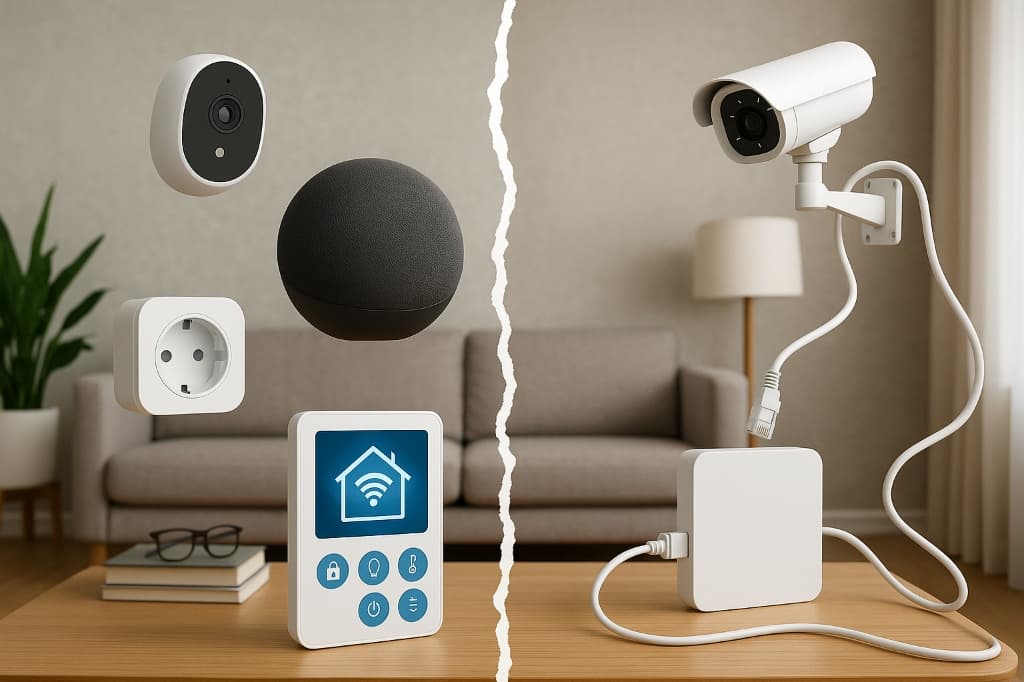
When planning a smart home, one of the most important decisions is: wireless or wired system? In this guide, we'll cover every aspect to help you make the right choice.
Quick Summary
| Factor |
Wireless |
Wired |
| Installation |
✅ Simple (1-2 days) |
⚠️ Complex (1-3 weeks) |
| Cost |
✅ Lower (~$6,200) |
⚠️ Higher (~$35,000) |
| Expandability |
✅ Easily expandable |
⚠️ Requires planning |
| Reliability |
⚠️ WiFi-dependent |
✅ 100% stable |
| Range |
⚠️ WiFi range limited |
✅ No limits |
| Application |
Existing properties |
New construction |
1. Wireless Smart Home Systems
What Is It?
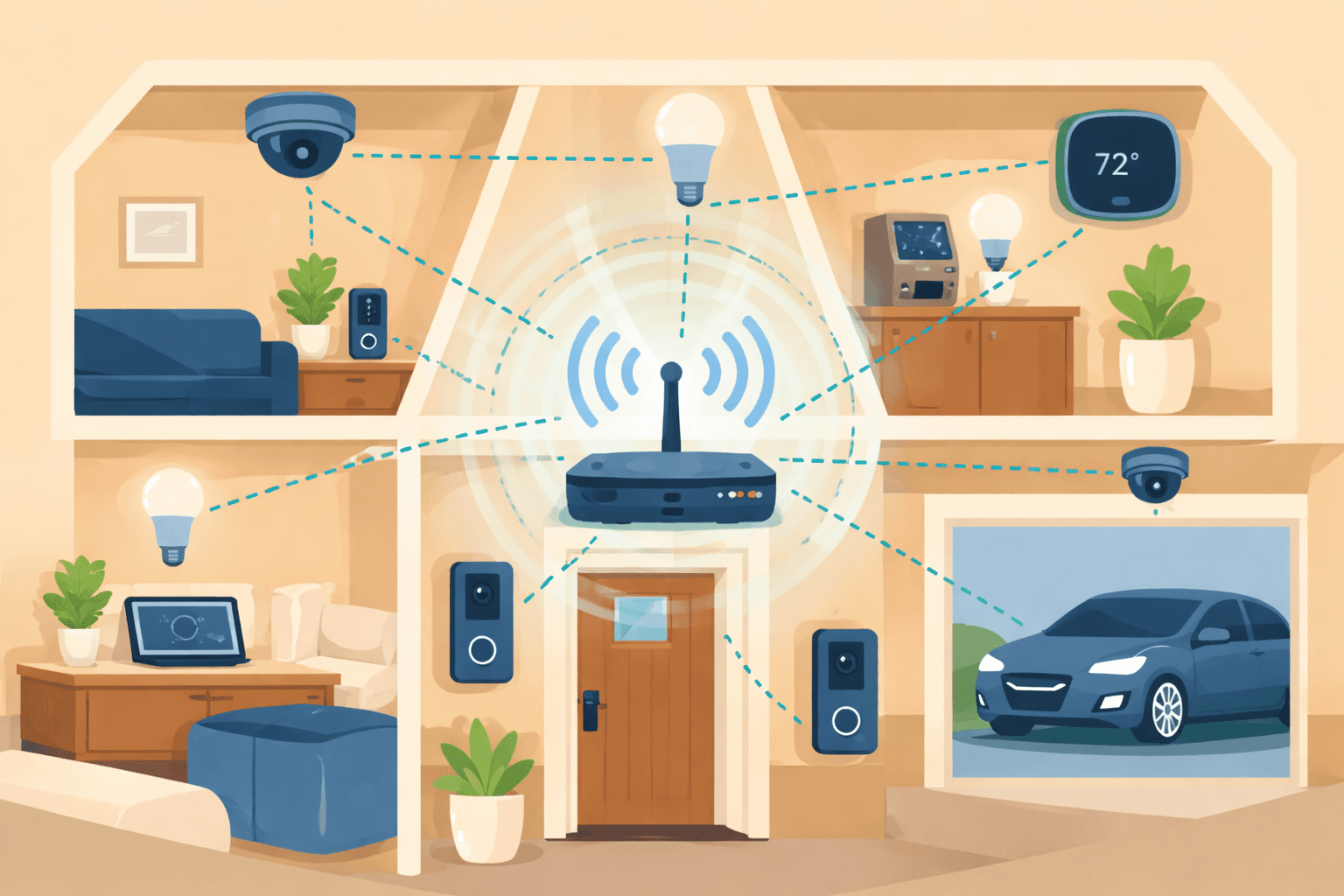
Wireless smart home devices communicate through WiFi, Zigbee, or Z-Wave protocols. No special cabling is needed - each device connects independently to the network.
Popular Technologies
WiFi Devices
Advantage: Work without a hub, simple setup
Disadvantage: Loads the WiFi network
Examples: Shelly, Sonoff, TP-Link Tapo
Zigbee Devices
Advantage: Low power consumption, mesh network
Disadvantage: Requires a hub
Examples: Philips Hue, IKEA Trådfri, Aqara
Z-Wave Devices
Advantage: Dedicated frequency (no WiFi interference)
Disadvantage: More expensive, fewer devices available
Examples: Fibaro, Qubino
Advantages
✅ Simple Installation
No demolition, no renovation
1-2 day professional installation
Fast deployment
✅ Lower Cost
Estimated cost for apartment: ~$6,200
Lower investment cost
No special cabling required
✅ Flexibility
Easily expandable
Devices can be relocated
Take it with you when you move
✅ Compatibility
Works with Google Home, Alexa, HomeKit
Devices from multiple manufacturers can connect
Regular updates
Disadvantages
❌ WiFi Dependency
Limited functionality if internet goes down
WiFi network load
Interference can cause issues
❌ Range Limitations
Large homes need WiFi extenders
Thick walls weaken signal
Gardens and basements difficult to cover
❌ Battery Replacement
Sensors need battery changes every 1-2 years
Maintenance costs
Environmental impact
❌ Less Professional Appearance
Visible devices
Less elegant
"Add-on" feeling
Who Does It Work Well For?
✅ Existing apartments and houses
✅ Renters (can take it with them when moving)
✅ Those with smaller budgets
✅ Those needing quick installation
Recommended Configuration (Apartment, 750 sq ft)
Main components:
Smart lighting system (12 points)
Smart thermostat and heating control
Security camera system (2 cameras)
Smart lock for entry door
Voice assistant devices
Additional sensors and outlets
Estimated total cost: ~$6,200 (with professional installation)
2. Wired Smart Home Systems
What Is It?
Wired smart homes are based on structured cabling. Every device connects to a central controller with dedicated cables. The most widespread standard: KNX.
KNX System
KNX is the world's leading smart home standard, supported by 500+ manufacturers.
Characteristics:
Bus cable (4-wire, 24V)
Central control
Programmable logic
Industrial reliability
Advantages
✅ Maximum Reliability
No WiFi dependency
No interference
30+ year lifespan
Professional grade
✅ Unlimited Expandability
Up to 65,000 devices
Multi-story buildings
Complex automations
Integrated systems
✅ Elegant Appearance
Hidden cabling
Designer switches
Professional finish
Property value increase (+10-15%)
✅ Future-Proof
Standard protocol
Manufacturer-independent
Long-term support
Resale value
Considerations
⚠️ Higher Investment Cost
Complex system cost: ~$35,000
Professional design required
Architectural and electrical planning together
Long-term investment
⚠️ More Complex Installation
Only recommended for new construction or complete renovation
Architectural planning required
2-4 week implementation time
Professional electrician and programmer needed
⚠️ Planned Modifications
Changes require advance planning
Expert involvement necessary for modifications
Structured expansion possible
⚠️ Specialized Programming
Professional software (KNX ETS)
Certified programmer
Expert configuration
Who Does It Work Well For?
✅ New construction homes
✅ Premium properties (2,000+ sq ft)
✅ Long-term investment
✅ Maximum reliability requirement
✅ With integrator involvement
Recommended Configuration (House, 2,000 sq ft)
KNX System main components:
Professional design and programming
KNX devices (switches, actuators, modules)
Structured cabling and installation
Touch panels and controllers (3 units)
Complex sensor system
Central control unit
Estimated total cost: ~$50,000
3. Hybrid Solution - Best of Both Worlds?
What Is a Hybrid System?
A hybrid smart home combines wired infrastructure with wireless devices.
Example configuration:
Lighting: Wired system - professional switches
Heating: Wired radiator valves and thermostats
Cameras: Wireless system - easy expansion
Voice assistants: Wireless devices
Advantage: Reliable foundation + flexible additions
Estimated cost: ~$25,000
4. Decision Matrix - Which Should You Choose?
Choose Wireless If:
✅ You live in an existing property
✅ No renovation planned
✅ You prefer quick installation (1-2 days)
✅ You want a flexible, expandable system
✅ You need a solution you can take when moving
Choose Wired If:
✅ You're building a new house
✅ Complete renovation is planned
✅ You're planning a long-term investment
✅ Maximum reliability is a priority
✅ Premium quality is an expectation
✅ Large property (1,500+ sq ft)
✅ You prefer elegant, hidden solutions
Choose Hybrid If:
✅ You need combination of new construction + flexibility
✅ Important areas with professional wired system
✅ Easy expansion with wireless devices
✅ You're looking for a balanced solution
Conclusion
In 2025, wireless systems dominate the market for apartments and smaller homes. They're more affordable, install faster, and are sufficiently reliable with professional installation.
Wired (KNX) systems remain the premium segment choice for large homes and new construction properties where maximum reliability and elegance are the goals.
Our best advice: Consult with a professional who can assess your property's characteristics and needs to create a personalized proposal - whether wireless, wired, or hybrid solution.
---
Free Expert Consultation!
Can't decide? Our free on-site consultation assesses your property and creates a customized proposal - with wireless, wired, or hybrid solution.
Request free consultation →Interested in smart home implementation?
Request a free quote and consultation from our experts!
Free Quote →